The Romance of Riga

I want to… but should I?… looks like I can’t… wait, maybe I can! 🙂

I fought a dozen thoughts before I caught one by its wings while I was two days from flying to Europe. It was never supposed to be a part of my plan. It was last minute. Then again, the best memories you make are never by design. I booked my tickets to Riga on a whim. And that is how I learned I should do such things more often – doing things on a whim, that is.

Riga's cityscape breaks the blue monotone of the river and the sky

Riga’s cityscape breaks the blue monotone of the river and the sky

Love at First Sight

When I first looked at Riga, I had to take off my sunglasses to see it with my naked eyes. Dazzling under the afternoon sun, the river Daugava glowed like sapphire. The endless waters seemed to separate the new town from the old, which were joined by impressive bridges. I saw the famous railway bridge made of iron – quite hard to miss since there’s always a train crossing it with its accompanying sounds. It was my first time in Latvia, and I could not tell the old town from the new one (at least from where I stood). So, I decided to toss a coin and cross the Stone Bridge (which is for cars and pedestrians).

The Latvian National Library

The National Library of Latvia

And that is how I ran into Latvijas Nacionālā bibliotēka, the silver building with an interesting architecture. After walking about on this side of the town for a few minutes and hardly finding any humans on the streets (the population here must really be low! 😛 ), I finally decided to open up Google Maps for help. But thanks to Murphy’s Law, it wouldn’t work! So, I did what I best do when I am lost – found me a place to eat. 🙂

At Picas Meistars

At Picas Meistars

In the tranquilizing ambiance of the quaint diner, I decided to stop being my own compass and texted my only friend in Riga. From our short chat, I knew I was on the wrong side of the bridge (that is, if there can ever be a “wrong” side). I ordered something with šampinjoni (mushrooms, if you really want to know) after some difficulty interpreting the Latvian menu. You will be delighted to know that English is rarely used in this country. That means, you have a great chance of picking up some Latvian. 🙂 (On the contrary, if you don’t like to open up to other cultures and languages, you will be in a tight spot! 😀 ) After crossing over to the Old Town, I managed to pose for a picture with the notable library in the background.

Blue and white - I did get my colours right! ;-)

Blue and white – I did get my colours right! 😉

Old Town

I entered Vecrīga (the Old Town of Riga) to the melody of a Latvian folk song. Strumming a blue acoustic guitar, stood a man by a lamppost at the centre of the old town. His partner, dressed in a long yellow frock, swayed and sang a fast paced country rhyme – or daina – as called in Latvian. Oh, how beautiful it felt to gaze at the towering steeple of St. Peter’s Church (first built in the 13th century) – with the perfect music to set the mood!

I could see that Riga was all out to impress me – first, leading me astray and building up the suspense; then, finally taking me on a musical date in the heart of Old Town. I had but 24 hours in Latvia, and my surprises had only just begun! 🙂

Fresh music in the Old Town - a poetic welcome!

Fresh music in the Old Town – a poetic welcome!

In Love and War…

I was awed by the impeccably maintained buildings which looked as though they had just been constructed. I soon discovered that most of these structures were first erected in the 13th and the 14th centuries. They saw the biggest of wars – The Great War (Polish-Lithuanian-Teutonic War) and the Second World War – and suffered destruction at the hands of the Germans and the Soviets.

It is almost ironical that the Germans in 1941 should bomb the House of the Blackheads – a church initially built for a guild of unmarried German merchants in Riga – Brotherhood of the Blackheads. Even its remnants could not survive for long as by 1948, the Soviets razed everything to the ground.

Dine under a patio umbrella in front of the House of the Blackheads

Dine under a patio umbrella in front of the House of the Blackheads

Riga is Born Again

Despite the wars, Latvia picked up its pieces and restored its heritage buildings. The Historic Centre of Riga is now a World Heritage Site, and tourism has gathered steam in the recent years after Latvia became independent again in 1991.

Strolling by the souvenir shops, one can’t help but notice cute figurines made of ceramic gracing the window displays. From sheep to barristers to village-huts, the mementos one can take back home are diverse. The red and white Latvian national flag is also visible everywhere.

Adorable little things that almost beg you to pick them up

Adorable little things that almost beg you to pick them up

Sauntering down the cobblestone streets of the Old Town, I counted rows and rows of houses that looked like they had come out of a children’s story book – red brick roofs, attics which looked like small houses themselves, windowpanes which appeared to have been made of ice-cream sticks, striped awnings, and even tall chimneys! So, these were the houses I had always been drawing in primary school! 😀

Gingerbread Man houses for real?

Gingerbread Man houses for real?

Meeting My Latvian Friend

I had wanted to see Riga for more reasons than one. 4 years ago, I was not even aware of a country called Latvia! I first heard of it when I was in interning in Lleida (see Lleida – A Reminiscence and Flashback to 2011: How I Started a New Life in Catalonia) and had a Latvian flatmate. This year, when I was planning my big Lithuanian run (see Running in Lithuania – My First Half Marathon Abroad), I couldn’t imagine not visiting my friend, Alise, who lived in the country right above Lithuania.

Riga did pop up once in a Bollywood movie (Agent Vinod), and I watched it at the theatre just to have a look at Riga. But that movie did no justice to the lovely capital city that Riga really is.

Groupfie in lowlight!

Groupfie in lowlight!

It was an emotional moment for both of us to meet after such a long time. Neither of us had really believed our paths would cross again in due course of time. We ate our dinners with a shot of Latvian balsam (a really strong spirit) and some pale ale from Bauskas alus, a brewery in the southern town of Bauskas. Then, my friend gave me the most beautiful parting gift by taking us on a walking tour of the city at night.

Dimly lit alleyways - perfect for romantic walks in the night

Dimly lit alleyways – perfect for romantic walks in the night

Riga at Night

Riga gets a makeover as the sun sets. From its colourful, cheerful self in the daylight, it transforms into a seductive, mysterious character. Depending on which part of the old town you are in, you will either find yourself amidst rows of nightclubs that play booming music and have a lot of partygoers celebrating loudly on the streets, or you will be able to escape into a quiet corner with not a soul in sight.

My love affair with Riga reached its crescendo when I found myself in this deserted cafe tucked inside the patio of an old building whose paint had chipped off to reveal the blood red bricks beneath.

The most romantic cafe in Old Town

The most romantic cafe in Old Town

I sat there looking up at the cloudless sky for a while before I decided to head back to my room.

Saying Goodbye

I woke up next morning excited for a new day of unplanned adventure, but I was sad to have to leave Riga. I stood by my window for a long time, taking in that unforgettable picture of the Old Town until I could remember it with my eyes closed. I left Riga at dawn, and our story would have to end there, like most romances that always have to end. They just cannot be perfect otherwise. That final image of the historic centre swathed in grey, before the sun fills it up with colour, will stay with me forever.

The silhouette of Riga as I last saw it

The silhouette of Riga as I last saw it

Have you ever been to a place and fallen instantly in love with it? Or did your love grow over time? Share your travel-love-story with me!

Lavasa – A Lyrical Journey in the Rains

I can open your eyes

Take you wonder by wonder

Over, sideways and under

On a magic carpet ride 

The carpet of smooth road welcomes us to Lavasa

The carpet of smooth road welcomes us to Lavasa

These lines from my favourite song in the Aladdin movie rang in my ears as we zipped through the mountain trail on our first monsoon roadtrip for the year. The road almost sang for me as it curved and split and sloped with alarming swiftness beneath us, almost taking us on a magic carpet ride over the Western Ghats!  I slid the car window down to feel the winds getting stronger as we gained altitude on the road to Lavasa. And after about five hours of playing hide and seek with the rains all along the path, we reached our destination. Hidden somewhere between the hills of the mighty Sahyadri range, a charming little city gleamed in the afternoon sun. I could not believe I was still in Maharashtra!

Just before the thunder split the sky

Just before the thunder split the sky

As the car eased into the driveway of our hotel – Mercure Lavasa, I made a mental note to find out why this city looked so Mediterranean. Weary as I was from the long drive, I almost flopped on my bouncy bed, but I realized I hadn’t had lunch. So, off we scurried to Mercure’s Celebration restaurant, and got hold of a table by one of the French windows. A view like that could only be enjoyed with Italian mains! After the appetizing meal of spaghetti and mushroom, we gathered our camera lenses and tightened our shoelaces – it was time for action!

Spaghetti with olives and grilled bread

Spaghetti with olives and grilled bread

As we walked through Lavasa, I learned that this planned hill station is modeled on the Italian fishing village of Portofino. Orange, yellow and brick red coloured buildings dazzled from afar. This was the Waterfront Shaw which framed the shimmering blue waters of the Wasargaon Lake. These waters are boundless in the scenes they reflect, yet restrained by the Wasargaon Dam. The mountains that guard Lavasa have an appeal of their own – they are gentle in their incline but strong when it comes to carrying entire villages on their backs.

The waterfront at Lavasa

The waterfront at Lavasa

My train of thoughts was broken by a little kid calling out to her father. She insisted on getting on the trackless toy train that chugged along Portofino Street. It was only then that I took my eyes off the mountains and looked around me. The lakefront promenade was lined with a host of counters that let one try everything – from miniature golf to adventure sports. Instantaneously, I broke into a smile as I knew just how I would spend the rest of my evening!

The toy train is coming!

The toy train is coming!

“Burma bridge crossing” was first on my list. This adventure sport can actually mislead people into thinking all bridges in Burma are made of ropes and only luck can help you go across. The operator from XThrill Adventure Sports warned me cheekily not to ask for help if I got stuck on the bridge. He hurriedly plonked a yellow helmet on my ashen face, straightened the harness around my waist and told me he’d see me on the other side. I held on to the rope railings for dear life as I wobbled across the rope bridge, stepping on one knot at a time. Zip lining, the next thing on my list, was a breeze after the Burma bridge ordeal. Zip line is also called Flying Fox, though you don’t quite feel foxy as you fly from one point to another, suspended only by two ropes. We tried our hand at archery and shooting before heading back to our hotel.

I tight-rope-walked across the Burma bridge

I tight-rope-walked across the Burma bridge

This hill city has a handful of business hotels and resorts, but not much for the budget traveler. In Lavasa, be prepared to loosen your purse strings! There are some cafes that dot the waterfront. If you love people-watching, you can sit and sip a different coffee under a different awning every time you pass a café by. For visitors who like to “feel” a place as opposed to tick things off a checklist, I recommend alfresco dining. No music is more melodious than the whistle of the wind, and no décor as enchanting as the mood of the sky.

The soothing sounds of water against rocks

The soothing sounds of water against rocks

Back at Mercure, we realized we still had some light before dusk would swallow the place. So, we decided to walk on the other part of Lavasa. Right outside our hotel, we heard a stream gurgling loudly with no other sound adulterating it. We walked past rows of single storey and double story houses which had no occupants but a guard to keep an eye on them. I guessed that many real estate investors have second homes here, but choose to stay in bigger cities. I cannot fathom why one would prefer noisier cities to the tranquil tunes of nature. In some time, the sky darkened with clouds and we strolled back to our hotel. I was a little upset that water-sports was closed in the rains. I just could not get the image of that expanse of hypnotizing blue out of my head.

The sky darkens

The sky darkens

To get my spirits up, we ordered Italian again. We had ravioli with some wine for dinner and then went out one more time to look at the diamonds that had scattered all over the night sky. The best thing about a weekend getaway to the hills is the crisp air and the clear skies. Stargazing is a luxury one cannot afford in big cities where light pollution is rampant. Over a bottle of Bordeaux and under a sheet of stars, we exchanged stories of our past and toasted to a brighter tomorrow.

Washed by the rains, the city gleams again

Washed by the rains, the town gleams again

We were greeted next morning by an intermittent drizzle that kept most of the tourists indoors and left all of Lavasa to us. With no group to trek with, we explored the place further on our own and spotted many a rare blossom and insects crawl out in the rain. Monsoon, I have observed, is more beautiful when you get out there and explore. A warm mug of coffee can only soothe your throat, not your soul. Rains are not for us to sit and watch from the confines of our glass walled homes. Rains are the Earth’s way to communicate with us. And we must reciprocate – by walking, running, driving and dancing in the downpour.

The hill station from the top

The hill station from the top

From where I stood, I saw at a distance, all the touristy cottages perched precariously on the hills. I knew then that I had escaped the tourist trap and wandered where only travellers could! I could then hear the true song of Lavasa.

Blessed by the heavens, Lavasa is crowned by a tiara of hills

Blessed by the heavens, Lavasa is crowned by a tiara of hills

Useful Information:-

  • Arrange your hotel bookings in advance, especially if you plan to visit over a weekend. Tourists start trickling in mostly in the monsoon.
  • Lavasa does not have an airport. The closest international airports are in Pune and Mumbai. There are also no trains or buses that connect Pune / Mumbai to Lavasa. Travelling by car is recommended. Besides, the enthralling views along the route are best enjoyed on a long drive!
  • If you are travelling in a bigger group, do not miss the morning tour conducted by Nature Trails.
  • For running enthusiasts, the Lavasa Hill Run is the cherry on the pie! Even if you are training for another marathon (see Running in Lithuania – My First Half Marathon Abroad), the hills of Lavasa could be your practice pit!
  • If you have more time on your hands, squeeze in a visit to Bamboosa – the bamboo factory. You can also request for a tour of the entire area, interact with the workers and see how a bamboo product is made – start to finish.

White Water Rafting in Kolad

“Rain, Rain, go away! Come again another day!” This is what most of us mutter under our breath when we are caught in a bad weather on a vacation. There are occasions though when rains bring out the best in the world around us. It is during monsoon earlier this year that my gang of girls and I decided to do something that is best done in the rains – river rafting!

The white waters of Kundalika

The white waters of Kundalika

Few places in Maharashtra have river rafting options, and Kolad happens to be the most popular. After many days of coordinating and searching for rafting-packages, we came across a perfect one offered by Mask Group. For as little as Rs.1700, they would take care of the commute from Mumbai to Kolad, arrange for the rafting activity and provide lunch and snacks.

What to Wear

For water-based activities, you must pick fabrics that don’t get soaked easily. Lycra and nylon are the best. Try to avoid cotton and denim as they tend to become very heavy once they soak up water, and don’t dry easily. You’ll have a higher chance of catching cold if you pick the wrong fabric. Wetsuits are probably the best outfits for white water rafting. You can wear either floaters or sneakers (without socks), but ensure that you wear something which cannot easily slip off your feet (flip flops, for instance). Most of us, however, showed up in whatever we liked. 😛

Our rafting guide briefs us before the adventure

Our rafting guide briefs us before the adventure

Before the Adventure

We started from Mumbai in the wee hours of the morning so we could reach Kolad by 9. It takes about 3-4 hours by road. We were 9 girls, but part of a larger group of 50 odd people in the bus which picked us up. We had our packed tiffins for breakfast in the bus itself and reached hungry for adventure! At the holding area, we saw dozens of air-filled rafts stacked atop one another, and safety-jackets, helmets and paddles arranged about a sheet of tarpaulin.

We pose with our paddles while we're still dry

We pose with our paddles while we’re still dry

Safety First!

The main rafting instructor told us that we were going to float over the Kundalika river. Its water is actually controlled by a dam, and the government allows for some water to be released everyday for rafters.

We were shown how to fasten the life-jackets which have a double-locking system for extra safety. There is an additional pillow-like padding on the jacket to keep your head above the water level when you lie flat on your back on the river. The helmets too are lightweight and help keep your head afloat, besides protecting you from getting hit by boulders. The water’s depth here is no more than 5 to 6 feet. But what makes it dangerous is the presence of rocks. Even though you won’t drown, you will injure yourself if you don’t heed your raft-captain’s commands.

All set to board the raft!

All set to board the raft!

Paddle Talk

One of the most important tools in rafting are the paddles. Made of ultra lightweight material, these not only help you row your way across the river but also come handy in rescuing fellow rafters who might fall off the raft. The paddle has three parts – a flat blade which pushes water, a shaft so light that it pops back up if you push it down the river, and a handle with a “T”-grip.

If you ever fall into the river, never leave your paddle. Hold it by the shaft towards the blade end and point the T away from you. Your rescuer will offer her/his T and lock it with yours. Once you get the locking right, the grip is impossible to break. You will be pulled swiftly to safety! 🙂

We rejoice after crossing our first rapid

We rejoice after crossing our first rapid

All Aboard the Raft

The world can be a little sexist at times. Our group of 9 girls was split into two and some guys were thrown in  for “strength”. Rowing really works up your biceps and triceps, and it is assumed men will be better at that sort of stuff. Anyway, we hauled our raft to the river and got aboard! Our guide sat at the back from where he could see us all and shout his steering commands. The front two rowers have to be the strongest and good rowers, and unsurprisingly two guys were made to sit there. We got in our positions and locked our feet under the air tubes in the front and back.

You might feel a little nervous on your first rafting trip, especially if you don’t know to swim. You are supposed to sit on the edge of the raft with your bum almost hanging out. Only your feet which stay locked under the tubes will keep you balanced. But don’t worry so much. You will enjoy the ride as you keep crossing one rapid after another! 🙂

The rafters jump off their rafts!

The rafters jump off their rafts!

Going Downriver

Along the 13km stretch of Kundalika, we negotiated about 10 rapids, mostly of grades 1 and 2. This is what makes Kolad a good place for beginners. You learn to test the waters before you aim for higher grades of rapids. Rapids are places where the smooth run of the river is broken by some turbulence, usually due to the presence of rocks or when there is a sudden decline in the water level. It is thrilling to cross a rapid as the water splashes aboard and bathes everyone on the raft. Depending on the sort of rapid it is, you will be asked to either row swiftly with a lot of force or “go down”. Going down does not mean jumping into the water, though. 😛 You must duck and crouch on the floor of the raft, holding the safety handle on the outside.

The water is cold! But good enough for frolicking! ;-)

The water is cold! But good enough for frolicking! 😉

Let’s Get Wet!

After about an hour of following our guide’s instructions to “row forward”, “row backward”, “left forward, right back” (to change the direction of the raft) and “stop”, we were treated with some time to gambol in the river! 🙂 Each of us was asked to jump into the water, and we sloshed about, dunking one another and posing for pictures. Note that there will only be one “dry-bag” on your raft for you to store your cameras and phones.

The rafts are taken back upriver on jeeps

The rafts are taken back upriver on jeeps

Hunger Strikes

After some more minutes of rafting on a relatively smooth stretch, we came to the end of our adventure. There were more than a hundred of us that day who rafted at Kolad! We carried our rafts back up the bank to the holding area and watched them being restacked and fastened to jeeps which would take them to the starting point for the next day’s rafters.

With all the fun behind us, we suddenly realized how hungry we were. We gobbled up some vada pavs at the snack shacks on the bank before our trek back to the bus. We were cold, wet and impatient to get out of our soaked clothes. The rafting areas have no changing rooms nearby, so you will have to drive to a resort to freshen up. After a 30 minute ride, we stopped at a farm.

We check into a rustic farm for a quick change of clothes and some warm food

We check into a rustic farm for a quick change of clothes and some warm food

Some Reflections

Glad to finally be able to change into warm and dry clothes, we settled to relish some freshly cooked Maharashtrian food. As we chatted about the day, we all agreed that we had made many new friends. That may not have been the case if all the nine of us had been on the same raft.

After lunch, we explored the farm and clicked away at everything that caught our fancy. I don’t think I have taken so many selfies and groupfies in one day. Only a bunch of girls can make that happen! 😀

After the rafting experience, we relax on a shack by the catchment area of our village

We relax on a shack by the catchment area of our village, planning our next getaway together!

Kolad is a great monsoon weekend getaway from Mumbai. Which is your favourite escape-zone from your city? Have you ever been rafting? Send in your replies! 🙂

Running in Lithuania – My First Half Marathon Abroad

I had been running various long distance stretches for almost two years, and half marathons in particular for about nine months. I did not think I was ready for what I was about to do in September 2015. But I took a leap of faith in myself and decided to do it anyway. A little more than a month before the D-day, sitting in my room in Mumbai, I booked my slot for the Vilnius Half Marathon. And that, my friends, is how this story started!

The pacers gather before the marathon

The pacers gather before the marathon starts

The Quest

For someone who had never run outside of Mumbai, this was BIG! I had not even run in a different Indian city or even Asian for that matter. One fine afternoon, when I was possessed by the idea of vacationing in Europe and running while I was at it, I started searching for half marathons in the continent. I had to park various marathons because they were either too expensive or had a qualifier which I did not meet or would have water/snack stations more than 5km apart (I just need something to sip/eat every 2km). When I came across the Danske Bank Vilniaus Maratonas, I had a feeling this one was made just for me – affordable, no qualifier, snack stations every 2 kilometers and also an English version of the site (and that is rare for European marathon sites, believe me)! 🙂

Who wouldn't want to run on roads like these!

Who wouldn’t want to run on roads like these!

The Litmus Test

I had a few challenges to conquer before I reached Lithuania. Firstly, the Lithuanian consulate in Mumbai does not do visa processing. But more on that later (in a different blog post). Secondly, if you participate in extreme sports (and marathons are considered extreme sports), you need a special kind of visa and your travel insurance amount goes up. I only had about a month to get to Vilnius and I had so much to do – book flights, plan my stay, arrange for documents for the Schengen visa… sigh! Administrative worries aside, I would also have to train for the run. With a full-time job that ate up most of my weekday time, I barely had weekends to get any running done. (And we all know weekends are sacred days meant for resting, partying and catching up with friends! 😛 )

The Neris River which flows all the way from Belarus!

The Neris River which flows all the way from Belarus!

Silver Linings

With the challenges though, came innovative solutions. I figured out my visa and tickets and everything bit by bit. I realized it is very easy once you tackle just one thing at a time. And for the marathon training, I joined a high-intensity cardio and pilates workout class in my office building. It did not seem to make much sense in the beginning. (Why would I waste my time worrying about flexibility and upper body strength when I would actually only need strong legs!) I thought initially that the post-work sessions were doing little else than raising my heart rate for those 45 minutes. But as the days progressed, I found that I was running better as my core muscles strengthened. My strides had become longer due to the increased flexibility in my legs. And as I had expected, my heart learnt to cope better with a faster heartbeat for prolonged durations. I had never trained for any run like this before. I would only rely on running, and simply more running. But only time would tell if this new regime would make a difference to my finishing time!

First Impressions

When I was finally in Vilnius (the capital of Lithuania), my Airbnb hosts were delighted to learn that I was going to be running. When I went to pick up my race-packet, I could feel the excitement building up. The volunteers wanted to take pictures with me and the locals were excited to see a foreigner from a faraway country. I must tell you now that I was the only Indian (and possibly the first one ever) to be participating at the Vilnius half marathon (I still can’t believe I hold that record 🙂 ).

Vingis Park from a bridge above

Vingis Park from a bridge above

The Goody Bag

The running kit had the usual suspects – my running bib, instruction sheets for the half marathon and some freebees (beer can, porridge mix, cod liver oil tablets, ankle guards and cold gel for pain relief). I was really thrilled though to see them give a complimentary energy gel. It is so hard to find one in Mumbai’s sports or medical stores. (I have been hunting for carbo snack gels for many months now, hoping some store would finally stock up, but no luck there.) You can only hope to order online or if you are one of those wealthy elite marathoners, buy gels from your trips abroad.

View from the bank - Vilnius cityscape

View from the bank – Vilnius cityscape

It’s All About Money, Honey!

People think running is the cheapest sport one can pursue. What does one need after all, save for a decent pair of shoes? Let me debunk that myth for you. As you have more runs behind you, you realize the importance of shoes with special features – extra cushion at the soles and ankles, form and memory retention, pronation-control, and what not! These sort of shoes from big brands cost you upwards of INR 7000. And because you don’t want to wear only one pair out, you invest at least in two. Then there is the question of good running clothes – tees and shorts/track pants made of sweat wicking (ordinary cotton can absorb sweat and become heavy) and anti-chafing material (most fabrics will cause rashes when they continuously rub against your skin). Depending on the brands you hanker after, this should set you back by another few thousand rupees.

The expenses rise if you are a woman. You additionally have to invest in some excellent quality high-impact sports bras (the yoga-variety simply won’t give you enough support). And because we like to be fashionable, the colour and design element will make it impossible for those to cost anything less than 3 grands. Many pro runners wear fitness bands, waist belts and hydration packs and carry all their gatorade, water and carbo-gels on their person. Some special trail marathons also require you to have a Road ID which can only be imported from USA. (Looks like I’m digressing from my theme.)

While I was running through Vingis Park - the largest park in Vilnius

While I was running through Vingis Park – the largest park in Vilnius

Marathon Day

Few moments compare to those I experience when I am running. On 13th September, 2015, I woke early and prepared me a nice meal of oats with yogurt. Vilnius was unusually cold for its summery September that morning. It must have been 9 degrees Celsius outside. For someone who had only run in humid Mumbai with the temperature seldom dropping below 20, it was fricking cold! I was almost about to wear stockings, but I stopped short of such buffoonery and got on with some thick moisturizing. When I stepped out of the temperature controlled house, I was hit by the gust of icy winds. Maybe I am exaggerating, but how else do you feel in flimsy sweat-wicking clothes when you’d rather wear an overcoat.

On that lovely morning, all modes of transport had been closed around the marathon route. That meant, I would have to walk 3km to the starting tents. It was good in a way as that gave me a chance to warm up well and adjust to the cold. Even the local runners found it cold! When I reached Cathedral Square (where all the runs would begin), I was dazzled by the carnival-like atmosphere! That day, Vilnius truly was a “marathon town”! There were runners from so many countries! Hundreds of locals had come out to cheer for us. I met a Polish girl who was running a half marathon for the first time in her life, and was the only runner from her village. We had decided to run together.

The amphitheatre inside Vingis Park

The amphitheatre inside Vingis Park

The Route

Despite such a huge international crowd, the announcements proceeded in Lithuanian. We knew it was time to run only when the runners before us started running. 😛

By now, you must have had a view of some of the places that my half marathon route took me through. I was so mesmerized by the natural beauty and old-worldly charm of Vilnius that I just had to stop and take a few snaps. We ran over bridges with the River Neris looking up at us from below, through the Vingis Park – the largest and most imposing park in Vilnius, past a stadium, an amphitheatre and a church, up a hill, on a forest trail with trees lining our narrow path, and up and down the undulating cobblestoned roads of the Old City. The run did not feel boring for even a second. We were entertained by several international bands, drummers, percussionists and dancers along the way.

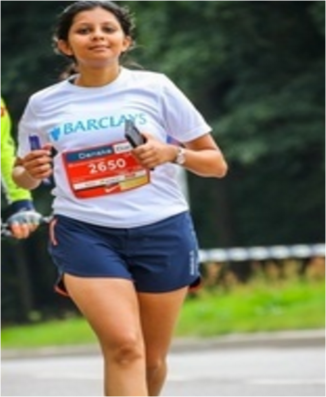
And...this is how I became the first Indian to run the Vilnius Half Marathon

And…this is how I became the first Indian to run the Vilnius Half Marathon

After the Run

The Vilnius Half Marathon was easily the toughest one I had run so far. Notwithstanding, I clocked my best ever time! 🙂 The credit goes not only to the new workout, but also to the clean air and the resounding support of the volunteers and spectators.

I did not have the energy after the run to wait for a free massage or stand for my turn in the shower-truck, so I stopped to buy a kibinai (a local delicacy) and after that filling snack, started for my long walk back to the flat. That morning, I had walked/run for more than 27km! When I reached my host’s place, she had a little surprise waiting for me! 🙂

My host made me comfort food for after my run! :-)

My host made me comfort food for after my run! 🙂

It was the sweetest and the most useful thing any host could do for a tired and hungry runner! She had made me cottage cheese and potato pancakes and left a couple of cute notes on how to eat them.

Vilnius saw me through my very first international marathon. I will hopefully go on to run many more runs abroad. But this one will always be the first. Always the most special – where it all started. I don’t have more pics from the run, but you can watch this video to see what it felt like:-

Have you ever run outside your home country? Or been on a “runcation”? I would love to hear your experiences! 🙂

Gurdwara Etiquette – Observations from My First Visit

I had often heard stories of Sikh benevolence from my friends who visited Gurdwaras. These friends were not just Punjabi Sikhs but also Bengali students who looked forward to the free langar in Rome when they found Italian restaurants a tad too heavy on their pockets.

I first visited a Gurdwara last winter on my trip to New Delhi. Delhi was just a stopover destination on that trip and I did not intend to do much sightseeing in the capital. While I scrolled through Foursquare for suggestions of good eateries in the city, I came across Gurdwara Bangla Sahib. I was surprised to see a house of worship on a list that otherwise only had restaurants and cafes. Instantaneously, I decided to visit the Gurdwara. This was my chance to unravel a mystery I was often fascinated with as a child.

The majestic Guru Bangla Sahib Gurudwara throws its resplendent reflection in the pond

The majestic Guru Bangla Sahib Gurdwara throws its resplendent reflection in the pond

Gurdwara Bangla Sahib is a palatial structure built of white marble with gold finishings. Four of its largest domes are wrapped in gold and exude the brilliance of the sun in the daytime. I learnt later that this opulent edifice was indeed a palace four hundred years ago – the abode of Raja Jai Singh.

Gurdwaras continue to welcome visitors without questioning their faith or religious loyalties

Gurdwaras continue to welcome visitors without questioning their faith or religious loyalties

The Gurdwara experience is quite an interesting one, especially for first timers. There is a sequence to how you proceed once you are inside a Sikh house of worship:-

Step One – Deposit Your Bags at the Luggage Counter

The first thing you do at a Gurdwara is take the weight off your shoulders. When your body is light, you focus better on taking the weight off your mind.

Step Two – Deposit Your Shoes at the Shoe Counter

In India, most places of worship will require that you remove your shoes. It is the same with Gurdwaras. Guru Bangla Sahib has several counters for devotees to hand over their shoes for safekeeping. Remember to collect your token and keep it safely. Your shoes will be handed back against the token.

Step Three – Cover Your Head

It is mandatory for everyone to cover their head inside a Gurdwara. Women generally wrap a dupatta over their head and men are expected to knot a headscarf to cover their forehead. You will usually find baskets of reusable headscarves which look like large handkerchieves in various colours and prints. Be mindful of this custom. Your headscarf or dupatta must never slip off as that is considered disrespectful. If it does, the volunteers point it out to you.

Step Four – Wash Your Feet

Washing your feet is an important step before you climb the stairs to the Gurdwara. I thought it was particularly intelligent of the builders to place a shallow water-tank right at the foot of the staircase.

Step Five – Buy Prasad

Guru Bangla Sahib has a structured way of accepting sponsorship for prasad (holy food). Prasad is usually a halwa – a sweet dish. You can buy a coupon for a nominal price and hand it over to the Gurdwara-worker designated to collect it. This step is optional, so those who cannot afford to pay can just skip this one. I suggest that you buy prasad if you have a big heart. Gurdwaras work mostly on charity and do a lot more charity in return!

There are queues for everything inside a Gurdwara and the proceedings are highly organised. After you collect your prasad-coupon, you exchange it for a bowl of prasad. But you cannot eat it just yet!

Step Six – Share Prasad and Enter the Shrine

This step is perhaps the highlight of my Gurdwara experience. There are two queues right outside the main building – one for those who have bought prasad, and another for those who haven’t. If you are in the first queue, you are supposed to hand your prasad-bowl to the Gurdwara worker. He scoops half of your prasad off your bowl and transfers it to a large drum of prasad (collected from more devotees like you). You take your half-filled bowl back and enter the building.

The people in the second queue (who come empty handed) are given a bowl of prasad from the same drum. This ritual brought tears in my eyes. Never before had I seen such a beautiful and structured way of sharing food. If only we could emulate this technique in our daily lives! This would solve the problems of hunger and poverty in the world.

At the centre of the gilded shrine, the Granthi reads the Sikh scripture

At the centre of the gilded shrine, the Granthi reads the Sikh scripture

Step Seven – Listen to the Granthi

The interiors of Gurdwara Bangla Sahib is even more grandiose than its exterior. The central place of worship gleams in its gold coloured carvings. The hall is large and peaceful with a high ceiling. The Granthi sits at the centre and sings prayers into the mic or reads the Guru Granth Sahib, the holy book for Sikhs. I am told that the Granthi in Sikhism is unlike a priest as in other religions. He has the same status as any other person visiting a Gurdwara. Anybody can be a Granthi and Granthis keep changing. This is a strong lesson in equality ingrained in Sikhism.

Hundreds of devotees either stand outside the railings that surround the Granthi’s pedestal, listening to the prayers, or sit under one of several hanging fans. The floor is either carpeted or there is cool marble to sit on. There is a separate seating area with chairs and sofas for the aged and those with problems of arthritis or mobility.

I watched a pair of pigeons quench their thirst as I ate the halwa

I watched a pair of pigeons quench their thirst from the Gurdwara-pond as I sat in the courtyard, quenching my thirst for peace.

Step Eight – Walk About the Gurdwara Courtyard as You Eat Your Prasad

You can either finish your prasad inside the main building or carry it outside into the expansive courtyard. I found me a nice shaded area on the white marble to sit on. The suji-ka-halwa, a semolina preparation, is the best I have had till date. Perhaps because it is generously swathed in ghee, or maybe because it is made with love…

The courtyard borders a serene body of water and I see the reflection of the impeccable Gurdwara floating on the deep blue waters of the pond. This pond is out of bounds for people. It is not meant for holy dips as I imagined it would be. I realize how my Hindu upbringing has conditioned me to expect things to be a certain way.

Step Nine – Relish the Langar

Gurdwaras are arguably best known for their langar. Langar is the main meal which is served all afternoon to every visitor, irrespective of their social standing or religious affiliation. Everyone assembles in a spacious dining hall – the langar hall, and takes a place on the floor in one of the multiple queues. Steel plates are provided to all and several volunteers (also known as Sevadars) take turns to serve all the dishes for lunch.

During my visit, I remember enjoying a wholesome meal of khichdi with ghee, makke-di-roti, aloo-subzi, papad and tomato chutney. These meals are cooked by volunteers and anybody can choose to volunteer. You need not be Sikh.

The meals served at gurdwaras are delightful not just because of the culinary skills of volunteers but also their devotion to serve

The meals served at Gurdwaras are delightful not just because of the culinary skills of volunteers but also their devotion to serve

Step Ten – Quench Your Thirst

There are water stations at several locations and you can drink to your heart’s content from bowls of water. My Gurdwara served water in bowls and not tumblers, which was very interesting.

Step Eleven – Collect Your Things and Spread the Love

After your visit is done, don’t forget to deposit the headscarf (if you borrowed one) and collect your shoes and bags from the designated counters. I know this is a long list of steps to remember. So, when you are confused, just do as the Sikhs do! Before I left the Gurdwara, I dropped some money in one of the donation boxes and took with me memories of a wonderful afternoon.

I was an observer throughout my experience inside the Gurdwara. If I have misunderstood any practice or gotten any step wrong, kindly correct me by leaving a comment below. If you too have had a Gurdwara experience, share your account with me. I am all ears! 🙂