My Airbnb Bucket List

A couple of days back, one of my favourite travel bloggers, Shivya, announced the AirbnbBucketList contest on her page. I posted my entries but I could not stop at that. The images of those beautiful dwellings found their way into my dreams and I’d wake up shattered by the reality of getting dressed for work and waiting for the day to end so I could get back home and dream some more. I read somewhere that keeping a dream-journal helps people deal with recurring dreams and understand the deeper meanings behind them. So here I am, writing about this particular dream that I saw thrice in the past 3 days…

This neat little cottage is tucked away in Mayne Island, Canada. But for now, it sits firmly in my head. The house appears as it if has been modelled by a kindergartener playing with Playdoh. It’s so smooth with no apparent edges! The roof curves fluidly, lending a kind of flexibility to the character of this edifice. The grassy patch around this quaint house is home to Opal & Onyx, the sheep that stay here and welcome new guests every now and then.

Onyx says hello to you!

Onyx says hello to you! (Source: https://www.airbnb.co.in/rooms/1720832)

I often enter this hut in my dreams and gasp at the tastefully designed wooden roofs and bamboo-stairway (to heaven, perhaps? 😉 ) I notice there’s a showcase full of my favourite books and a basket next to it. I decide instantly to fill my basket with a book and head outside to enjoy the summery skies and short tales.

The inside story (Source: https://www.airbnb.co.in/rooms/1720832)

The inside story (Source: https://www.airbnb.co.in/rooms/1720832)

I re enter this tiny paradise and fall fast asleep in my circular bed with half a dozen pillows to keep me comfortable. I wake up to find I have a splendid view outside – the sun is bright and the forest, green. I walk out onto the balcony and breathe in the fresh woody air.

The room upstairs (Source: https://www.airbnb.co.in/rooms/1720832)

The room upstairs (Source: https://www.airbnb.co.in/rooms/1720832)

I realize I am hungry now. I head down to the S-shaped kitchen. The counter has some scones, I see. I put some tea leaves to boil in a kettle. I pick up some butter on my way out of the kitchen with my plate of scones and a cup of tea, to sit outside in my balcony with nature again…

But before I bite into any swirl of scone, I hear the doorbell. Immediately, I rush to answer the door, but the door brings me back to the present, and I find myself sulking on a Monday morning. From the rustic peace in Mayne Island to the noisy streets of Mumbai – I return to the grind of daily-life, and long for that dream to come true someday…

*  *  *

The title of this post is rather misleading. I don’t have a list, just a little dream. If you too dream of living far away in a lovely cottage, enter this contest now!

Daman – Developing through Tourism

With spring’s stolen colour

The water shows me sky.

Gujarat’s younger neighbour,

Daman, is anything but “dry”!

Clear skies in Daman

Clear skies in Daman

52 years after its independence from Portugal, Daman nurtures new lives in this small union territory in India. With the intention of relaxing in its beaches, I marched along this little city in the month of March this year. But little did I know that a glimpse into Daman’s past would make me cognizant of  the effects tourism has had on this coastal wonder.

This report on the 20-year plan that the government announced in 2002, highlights how effectively tourism will harness Daman’s unique offerings and make it a win-win-win situation for the economy, the locals and the environment!

  • The now deserted forts of Moti-Daman (Big Daman) & Nani-Daman (Little Daman) were once guarded by the Portuguese. However, with the intervention of the Tourism Department, these forts will soon have more visitors. Travel-packages that include heritage-walks, local cuisine and cultural shows will bring equal joy to tourists and the locals as they find more employment-avenues.


  • Positioning Daman as a pocket-friendly vacation-spot, the administrator is boosting its infrastructure. The construction of several bridges and a coastal highway are already under way. The most useful bridge, according to me, is the one that connects Moti Daman to Nani Daman. The other route will set you back by several hundred Rupees. I always wondered why the backwaters couldn’t be navigated via boats (which the fishermen use on a regular basis), and was ready to shell out more just to bob up and down the water. My prayers will soon be answered.


  • The Waterfront Development Plan aims to maintain & develop the Devka & Jampore beaches, along with the Daman Ganga river and the place where it meets the Arabian sea. The waterway between Moti and Nani Daman is set to be opened to tourists! 🙂 The entire beach-line will get a retaining-wall to reign in beach-erosion. The sand on these beaches may be dark, but their future is certainly bright!


  • The focus of this mega-plan is on the conservation of nature. Special care is being taken to avoid adverse impacts to the environment, with the alternate recourse being mitigation & compensation. The international cycle-track (under construction) is the hottest attraction in this soon-to-be eco-tourism hub!


  • The inhabitants will now have a special part to play in the bigger scheme of things. Heritage walks and interaction with locals will now take tourists to Portuguese-style settlements too! Locally handcrafted bamboo and leather products are as much in demand as alcohol and fish. This spells a huge boon for the aboriginals.


This slideshow requires JavaScript.

Daman was once regarded as the most poluted of all beaches due to industrial wastes leaking into its waters. But all that is now set to change for the better! Cleaner beaches, water-sports, boat-rides, walking tours, village-interactions… Do you need any more reasons to pack your bags and head to Daman?

Ville Blanche – Pondicherry’s French Kiss to India

I had been day-dreaming about the quaint little streets of Pondicherry for almost a year before I finally booked my tickets and decided to realise my fantasies.

Earth meets heaven

Where Earth meets Heaven

Puducherry is not just a union territory in India, it is a world of its own. The Franco-rule that lasted here for almost 300 years, has soaked this place in its colours and flavours. To savour the ultimate French experience of La Côte d’Azur de l’Est, I decided to stay at Le Dupleix.

The colonial interiors of the luxury boutique hotel (Le Dupleix)

The colonial interiors of the luxury boutique hotel (Le Dupleix)

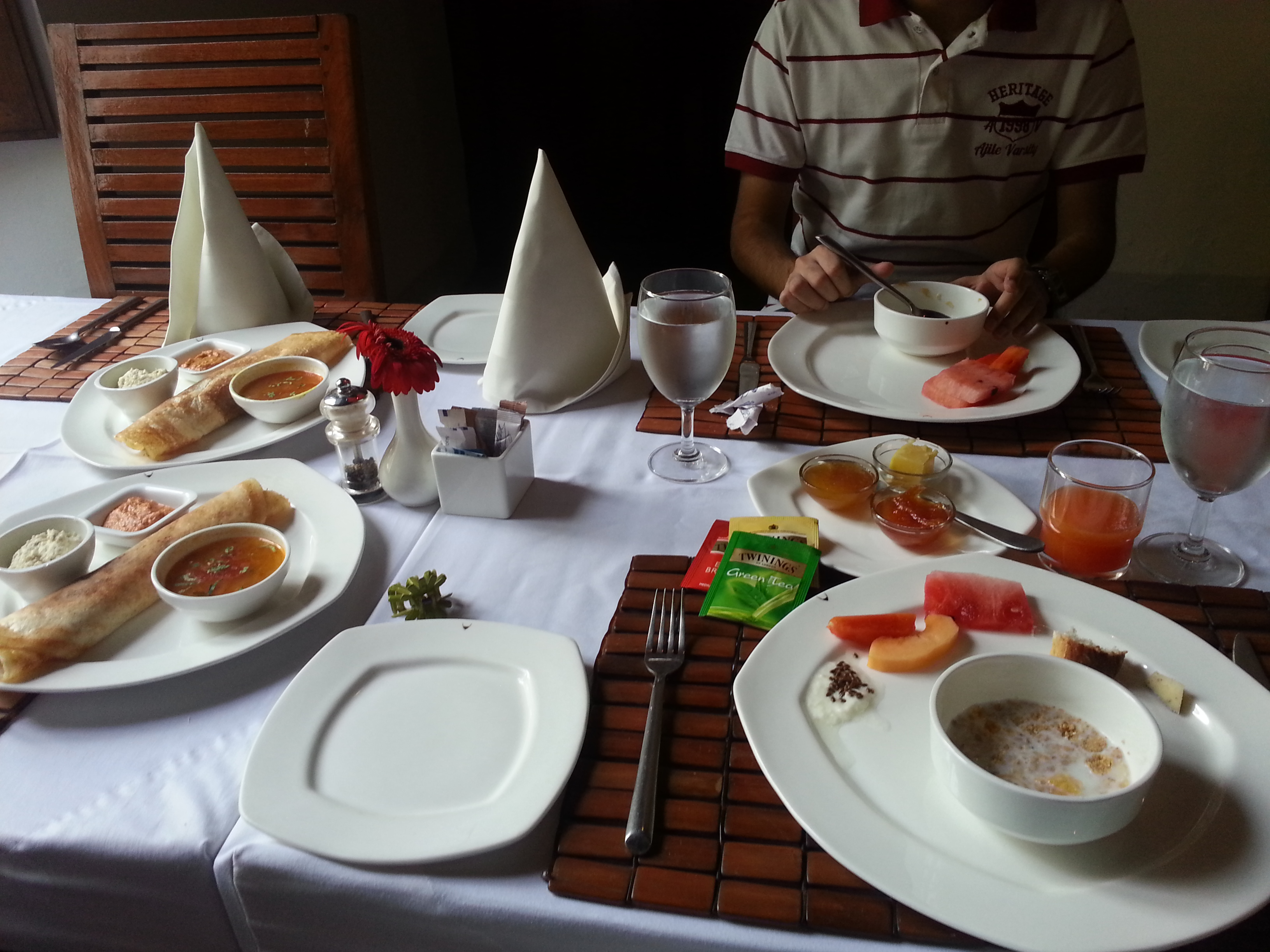
I started my Pondy-trip with a hearty meal of milk and cornflakes, fruits, flax seeds and orange-juice. Then gorged on some dosa-chutney and sambar while I waited for my green tea to arrive. (My appetite doubles when I am on a trip!)

The Tamil-English breakfast

The Tamil-English breakfast

With my stomach full, I started walking through the grid-like rues (roads) that lead me to this mustard building…

The French Embassy

The French Consulate

And then, there was another. This one in memory of the French soldiers.

Foyer du Soldat

Foyer du Soldat

I entered the Pondicherry Museum, which housed everything – from stone-sculptures dating back to the 1st century AD to ancient carriages that lived to see me visit!

Vintage carriages

Vintage carriages

To pay some heed to my roused hunger, I halted in front of Le Vietnam, where I had my lunch of bún chả with a pair of chopsticks while I stared wide-eyed at an interesting looking nón lá (Vietnamese conical leaf hat).

Post lunch, I rushed to the nearest church, just in time to hear the mass in Tamil!

Our Lady of the Immaculate Conception cathedral

Our Lady of the Immaculate Conception cathedral

I reached the Promenade beach before sunset and walked the entire stretch. The locals told me I should stop to look at the Gandhi statue and the French war memorial, which I dutifully did.

When the sun dissolved into the waters of the Bay of Bengal, the street suddenly came alive! One could watch the Pondy-Police-Force play the trumpet, activists staging street plays, live music and dancing all along the way. The once empty road was now thronged by a sizable crowd, and the mood was that of a carnival. It was, in fact, a carnival as today was St. Bastille’s Day! I was just lucky to be at the right place at the right time.

Bastille Day festivities

Bastille Day festivities

After the noise-overdose, I had a quiet dinner at my hotel. I ordered Italian – the cuisine that makes me think of nothing else but what’s on my plate. I then proceeded to catch some sleep for my trip to Auroville the next day!

Ravioli con funghi (Ravioli with mushroom)

Ravioli con funghi (Ravioli with mushroom)

Sauntering through Salt Lake City

I spent this morning sitting on rows of bamboo-rods, gazing at the vastness of the waters of Nalban, as the breeze caressed my hair. I wondered how this place could be so cool in contrast with the heat that radiated from Bengali fishermen who cycled to this place.

20131124_093144

Fishing area at Nalban

Kolkata – a metropolis famed for its fresh water fishes, has a popular satellite city called ‘Salt Lake‘. They say it’s a posh area where residents seldom speak to their neighbours. That explains the tranquil airs that transmit little other than the sounds of chirping birds. Salt Lake is known in the football-circles for its famous stadium. But the multicoloured bungalows that line every street are what catch my eye. The houses that start from a single storey and go up to 5, are painted in all colours imaginable to mankind. These are alternated by some very rustic buildings that have weathered the monsoon and cried their paint out.

A colourful bungalow in Salt Lake City

A colourful bungalow in Salt Lake City

I noticed at some distance many old ladies in salwar-kameez and sneakers brisk-walking out of a park, and instantly decided to walk in. This was Banobitan University Park, or more poplularly, Central Park, a sprawling enclosure of green and purple flora that are ornamented by white egrets. At the centre of this park is a lake that is opened for boating from 10am to 5pm.

20131124_091432

A tree house inside the Banobitan University Park

Bengalis, by nature, tend to exaggerate most things. They scared me into carrying woollens and a scarf to this trip. But I discovered that the light chill in the air didn’t warrant warm clothes. Most pedestrians, however, wore chequered sweaters, mufflers and wrapped embroidered shawls tightly around themselves. I noticed also that the locals love their cotton. They will wear multiple layers to insulate themselves from the cold but will never part with their cotton-clothes.

Cotton sarees hung out to dry

Cotton sarees hung out to dry

In Kolkata, there will be new streets, new metro-corridors, new flyovers and even multi-storeyed office-buidings, but some things will never change. The Ambassador is one of them. These taxis from the last century still ply on the narrow Culcuttan streets alongside the quintessentially Bengali rickshaws.

An Ambassador (taxi) and a cycle-rickshaw

An Ambassador (taxi) and a cycle-rickshaw

The only thing more enchanting than the places and vehicles in Calcutta are the people. They are loud when they scream and sell their wares, yet soft when they invite you over for a meal; frustrated with the traffic and the political scenario, yet glad to live in their jonmobhumi (birthplace). Their faces hold a million expressions at the same time – anger, joy, pride, disgust, relief, fear, despair, frenzy, abhorrence and love. Perhaps this rare quality of holding so many emotions and still not losing their equilibrium makes Bengalis so beautiful to behold.

A cane-furniture vendor making his way through the crowd

A cane-furniture vendor making his way through the crowd

I have been visiting this city every year for more than two decades now. But this time, my eyes see what they’ve never seen before. Stay tuned for more posts in the Kolkata-series, as I take you through the heart and soul of my jonmobhumi

Eating, Shopping & Staying Smart in Jaipur

This is the concluding post of the Jaipur-series. You can read about my trip to Jaigarh and Amber also.

Food is an essential aspect of any trip that cannot be ignored. To truly taste the Rajasthani culture, one must taste its local cuisine. And to do this, my relatives and I headed to Chokhi Dhani. Chokhi Dhani means “good village” in Marwari, and true to its name, this theme-park exuded an earthy charm. The turbaned receptionist sprinkled rose-water on us, smeared a vermillion tilak on our foreheads and greeted us with “Ram Ram-sa!

It was a chilly evening but the warmth of the locals nullified the dip in the temperature. The scene was that of a small village-fair, with kathputli (puppet) shows, music & dance performances, mehendi (traditional tattoo) tents, food-stalls that served chai and pakodis, magic-shows and a series of game-stalls where one could try one’s hand at shooting, archery and umpteen other recreational activities. There was a special dandia-floor for people with twinkle-feet who could join the dandia (a dance in which a pair of sticks are used as props) & garba dancers. Further inside, the fair unfolded into an exhibition of local arts and crafts. Tourists could browse through and buy locally sourced garments, furniture, toys, leather-goods and gift items. Chokhi Dhani offers photoshoot opportunities in the local apparel, and also elephant, camel & horse-rides! I had my first camel-ride here, and felt my heart in my mouth as I struggled to balance myself on the wobbly seat several feet above the ground.

The village-home-style dining experience was the main attraction of the night for me. We sat on flat cushions spread on the floor and were served on leaf-plates and bowls and an earthen tumbler. The men who served the dishes egged us to eat more – “Khao, khao! Aur khao! Kitne duble patle ho gaye ho!” (Eat up! Eat up! You’ve worn thin!) The food was a sumptuous Rajasthani fare of bajre-ki-roti (millet flat-bread), makke-di-roti (corn flat-bread), soybean-chat, pudina-chutney, gatte-ki-subzi (gram-flour curry), daal-baati-churma (lentils, wheat-ball roll & sweet), halwa, sarson-da-saag (mustard-leaves veggie), mithi khichdi (sweet mashed rice) and salad (mostly lettuce). And everything was smothered in desi-ghee (clarified butter). I stopped only when my stomach threatened to burst open my jacket 😛

My trip to the Pink City ended with more shopping on my last day there. And you must know that returning empty-handed from a place like Jaipur is nothing but foolishness. So I’ll save you some embarrassment with some shopping tips.

Shopping in Jaipur – What, Where & Why :-

  • Colourful jootisbatuas (small handbags) from street-side shops, because of the unique designs & the slimming effect they have on the feet.
  • Cotton kurtas with Rajasthani cuts and prints (especially bandhani) from the bazaars or exclusive boutiques, for the comfort they provide in the summers. The bazaar-kurtas start from as low as 80 Rupees and the shopkeepers insist the cheap ones are of excellent quality when you ask to see something more expensive! 😀
  • Finished jewellery of German silver, precious and semiprecious stones, because of the workmanship of the jewellers and the intricate designs on the ornaments. Remember to collect the authenticity-certificate if you buy (semi)/precious stones.
  • Soft blankets/comforters/quilts from Bapu Bazaar, because these are light, wrinkle-free, washable & the softest blankets in India.
  • Wood, lac, mirror and painted-glass artefacts (pen-stands, wall-hangings, key-chains, coasters, show-pieces & even ornaments) for giveaways to your friends & family back home. Remember to pack lac-items well; they are fragile.
  • Multani-mitti-pressed saree, for its soft, off-white look.

Travel-tips that others won’t share with you (specific to Jaipur):-

  • Plan your heritage-site trips well and start early as most forts/palaces close for visitors by 5 or 6 in the evening.
  • Elephant rides can be availed in the early mornings and late evenings only as it gets too hot for the animals to walk about in the afternoons.
  • Hire a full-day cab so you can leave your shopping bags inside and travel freely.
  • Wear sneakers when you hit the road. Resist the temptation to wear short flowing skirts and stilettos to sites where you’ll have to walk for miles and ascend many steps. (Just to give you an idea, it’s very hard to walk on cobbled streets even with good quality sports-shoes.) Remember: It’s always a choice between glamorous photos and memorable experiences.
  • Pack some food and water for the road with you. Energy-bars go a long way in satiating a growling stomach when you can’t find a restaurant in sight – these are compact, weather-proof, & pack a punch! Remember to buy bottled water whenever you can. Once inside a fort, the vastness and the glaring sun can leave you parched in no time.
  • Take a leak wherever you find a restroom, irrespective of whether you need to. (In India, you can never tell when or where the next loo will be.)
  • Hire guides. They’re worth their weight in gold. They are also good photographers and excellent for you if you’re a solo-traveller, because you can’t always bug strangers (fellow tourists) to retake your pictures til they get the perfect shot.
  • Carry scarves. You’ll need these both in the summers & the winters and to add a dash of colour to your outfit. (Rajasthan is so vibrant, it can make any colour look drab!)
  • Don’t be shy to loosen your purse-strings a little. Every experience is worth every penny it commands.

Please share your Jaipur-experiences with me and write to me about all the things you’d like me to talk about.