Kolkata with my Eyes Closed…

We experience so many sensations when we visit a place. Some dazzle us with their visual appeal, some delight us with their melody, some flatter our taste buds with their strong or subtle flavours. And then there are those that refuse to leave us when we have long left the place. Today, I’m going to talk about some sensations that have attained a state of permanence in my subconscious. And most of these are deeply linked to the distinct scents they carry.

Of all the smells that my olfactory faculties sense, those originating in Kolkata remain the most powerful. Last year, my mum and I booked our tickets, packed our bags, and set off to “the city of  joy”. Here’s the first meal that greeted us:-

A full Bengali meal

A full Bengali meal

The inviting aroma of warm mung dal drew me out of my room and I decided I should unpack later. Before me was a large plate full of Bengali delicacies. Food so flavourful is eaten with hand! The hot meal was spiced with asafoetida and turmeric, but there was a perfect balancing element – the sweet dish. The blood-red tomato-chutney was subtly sweet and tempered with black sesame seeds. But my favourite dish was mishti doi, the famous pink-tinted yogurt which is sweetened with khejur-gur (date-jaggery). Served in a small earthen urn, mishti doi always manages to tranquilize me with its delicate scent of succulent dates that mixes with the smell of  baked earth.

Horse-carriages from an era bygone

Horse-carriages from an era bygone

Kolkata feeds not just your body but also your mind. On our way to Victoria Memorial, we walked past a string of royally embellished carriages drawn by handsome Arab stallions and English thoroughbreds. I don’t know what the 18th century smelled like, but to me it smells like fresh paint blended with hay from horse stables. This unusual odour is so potent, it makes one dream of the times one only reads in History textbooks.

Human cart

Retirement? What is that?

When one thinks of the olden times, one cannot help but notice old age. I walked around the streets to find several rickshaw pullers awaiting their customers. Quite a few amongst them were well past their middle age; their hair, a snowy shade of white; their salt-and-pepper beard, more salt and less pepper. In the damp air, I smelled their spirit and strength to carry on with work and let age only remain a number.

The 'sisters' at the annual procession

The ‘sisters’ at the annual procession

Kolkata is full of noises – the bleat of a cycle-rickshaw horn, the holler of a bag-seller, the ringing bells of a tram, the creaking of a rickety State-bus and the constant shuffling of feet. But I found peace amidst the noise – several nuns (from Mother Teresa’s Missionaries of Charity) walked quietly through the streets at their annual procession. If peace has a smell, it’s most certainly that of starched cotton.

Nepalese momos in Calcuttan streets

Nepalese momos – Calcutta’s street surprise!

This city can start feeling like home in a few days. The Albanian Saint Teresa stayed back in Kolkata for many years and so have people from various other countries. The intermingling of different tongues has also brought about a revolution in the Bengali food circuit with the introduction of many cuisines. The momos, every other Bengali’s favourite, are actually from Nepal. For only 20 rupees a plate, these momos are a steal! The stuffed, steamed dumplings come with a spicy dip and a bowl of piping hot soup. I take one long whiff of this street food and my brain instantly declares Chinese! But I bite into a tender momo and know this is definitely not Chinese.

The Bangali puchka

The Bangali puchka

Once enamoured by a street-snack, I can’t help but dig into some more. I reach a puchka-stall and order a round of serving. The ellipsoid puris are like nothing I’ve seen before! These flour-crisps are bigger and longer than the regular spherical puris one sees in the rest of India. The smell of tamarind in the puchka-water makes me ask for another round of puchkas!

Ever been invited for a Bengali tea break?

Ever been invited for tea at a Bengali’s?

Eating in Kolkata doesn’t only happen outside. In fact, it mostly happens in the homes of the locals. The snack-spread in Bengal is slightly different from the elaborate lunches and dinners. Tea time is an intimate moment of reflection and discussion on all matters that affect the world. Friendships are forged over the aromatic Darjeeling tea or the malty Assam tea with some sugar-coated biscuits on the side. Bengalis drink tea like a European would wine. Tea is first tasted with the eyes as one discerns whether the colour is strong or translucent. The teacup is then brought to the nose to appreciate its aroma. It is finally sipped and gulped with some knowledge of the flavour.

I can distinctly smell Kolkata when I close my eyes, every fragrance becoming clear to me. Do you ever notice the smell of a new place? Has any place left a scent in your soul?

Lleida – A Reminiscence

Today, I’m going to tell you a story set in a Catalonian province – Lleida. This story will take us three years back in time as we retrace my journey through this beautiful region in the summer of 2011.

A cobbled bylane in Lleida

A cobbled bylane in Lleida

My joy knew no bounds the day I found out I was going to “Spain” for my summer internship. This would be my first solo-trip out of India. I did plenty of research on Lleida (pronounced ye-ee-da) and practised some basic Spanish which I thought would help me get by.

But nothing prepared me for what I would experience here. And nobody told me this trip would transform me as a person.

I had changed 6 modes of transport to reach my place of stay!

  1. I boarded my Swiss flight at 1AM from Mumbai and spent the entire night checking out their awesome inflight entertainment options. Needless to say, I was sleepy when my plane landed at Zurich.
  2. At the Zurich Kloten Airport (one of the prettiest I’ve ever seen), I took the inter-terminal train to reach the terminal for my connecting flight.
  3. Then, I boarded the early morning Swiss flight to Barcelona. This is where I first strained my ears to interpret the Spanish-English accent. “But airhostesses in all countries always speak in unintelligible accents”, I shrugged.
  4. After an hour of sleep on the plane, it was time for me to collect my things and catch the shuttle that would take us from the international terminal of the Barcelona–El Prat Airport to its domestic one.
  5. From there, we (“we” because 2 more interns joined me at Barca 🙂 ) took the metro to the Barcelona Sants train-station.
  6. We next caught a train to Lleida.
  7. And the final journey from Lleida station to our apartment complex was in our host’s car. Phew!
The mighty Pyrenees through my window

A charming hill (not the mighty Pyrenees) through my window

I was mostly dozing by the window on the Renfe-train but managed to catch some panoramic glimpses of the Pyrenees mountains. I thought the coach was unusually quiet (by comparison to Indian train-coaches), almost as if it were a library. (I would learn on my subsequent journeys that the Europeans are not as noisy as we are.)

It was such a delight to meet Marc, one of our hosts, who drove us to our final destination.

Estació de Lleida Pirineus

Estació de Lleida Pirineus

Before I could show off the little Spanish I had learnt, Marc proudly told us he wasn’t fond of Spain. And most Catalonians wouldn’t reply in Spanish if we asked them.

He erased my shock and confusion by explaining to us how Catalunya (as the locals call it) is trying to secede from the rest of Spain. But we didn’t have to worry about knowing no Catalan as the University of Lleida provided us welcome packs which had a translation-guide! 🙂 In the anticipation of learning another foreign language and meeting more interns at my apartment, I forgot that I hadn’t slept for almost 20 hours.

With the hosts & other interns

With the hosts & other interns

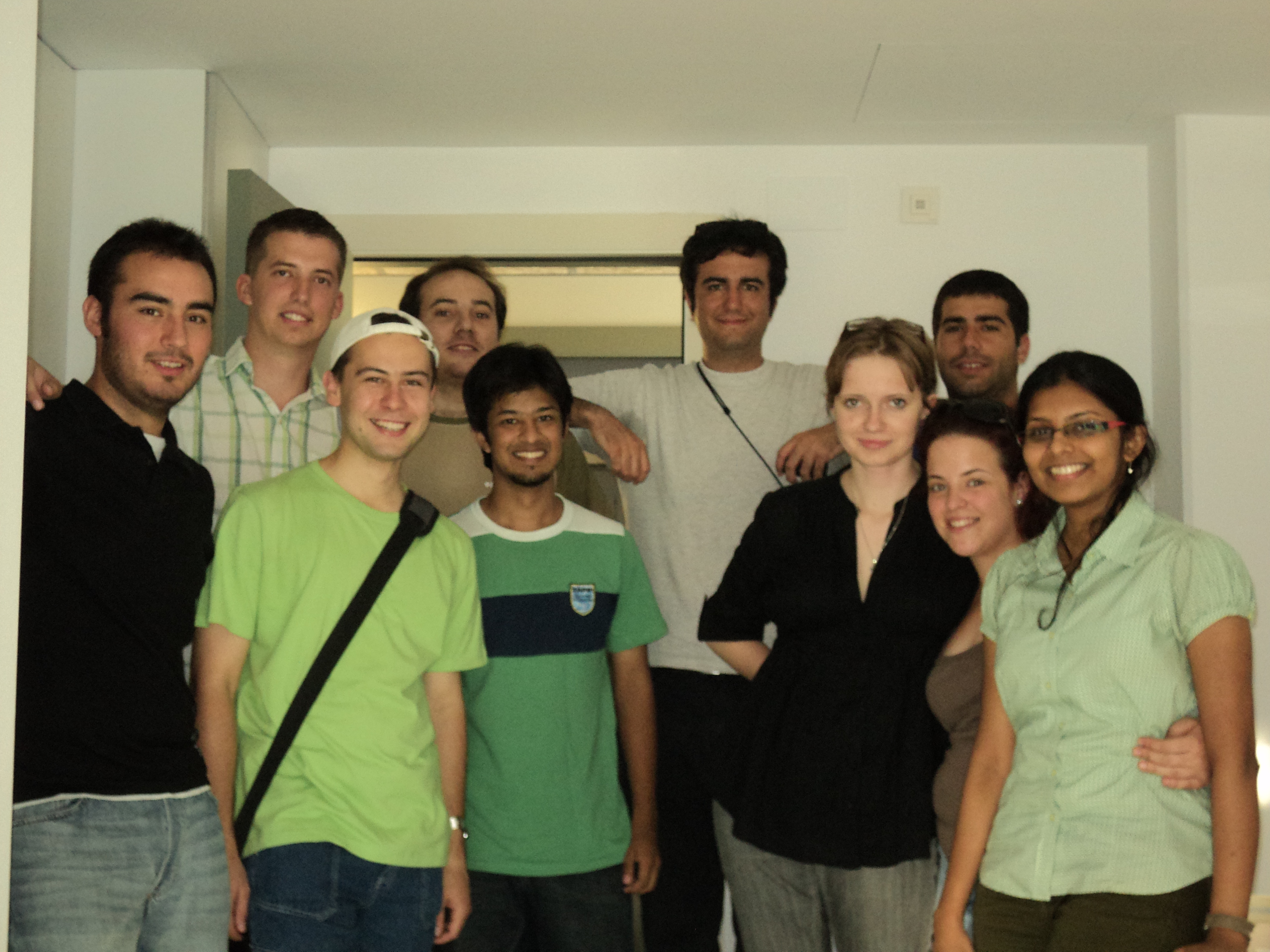
Summer in Lleida’s latitude means the sun won’t set until it’s past 9.  My watch said it was time for dinner, but my eyes refused to believe. This is when all the first-day (night, maybe?) fun started! I met all the hosts, and fellow interns from Belgium, Latvia, Germany, Mongolia, Peru, Greece, Panama & Belarus. Our Catalonian hosts had prepared a sumptuous spread for all of us. I too brought out my theplas (my mum fretted too much about food and whether I’d get anything to eat at all 😛 ) for everybody to try.

Did you know?Theplas taste better with gazpacho!

My last memory of staying awake that night ends in having some red wine and Picón cheese before I give in to jet lag and sleep-deprivation, and find myself sleeping like a log in my bedroom.

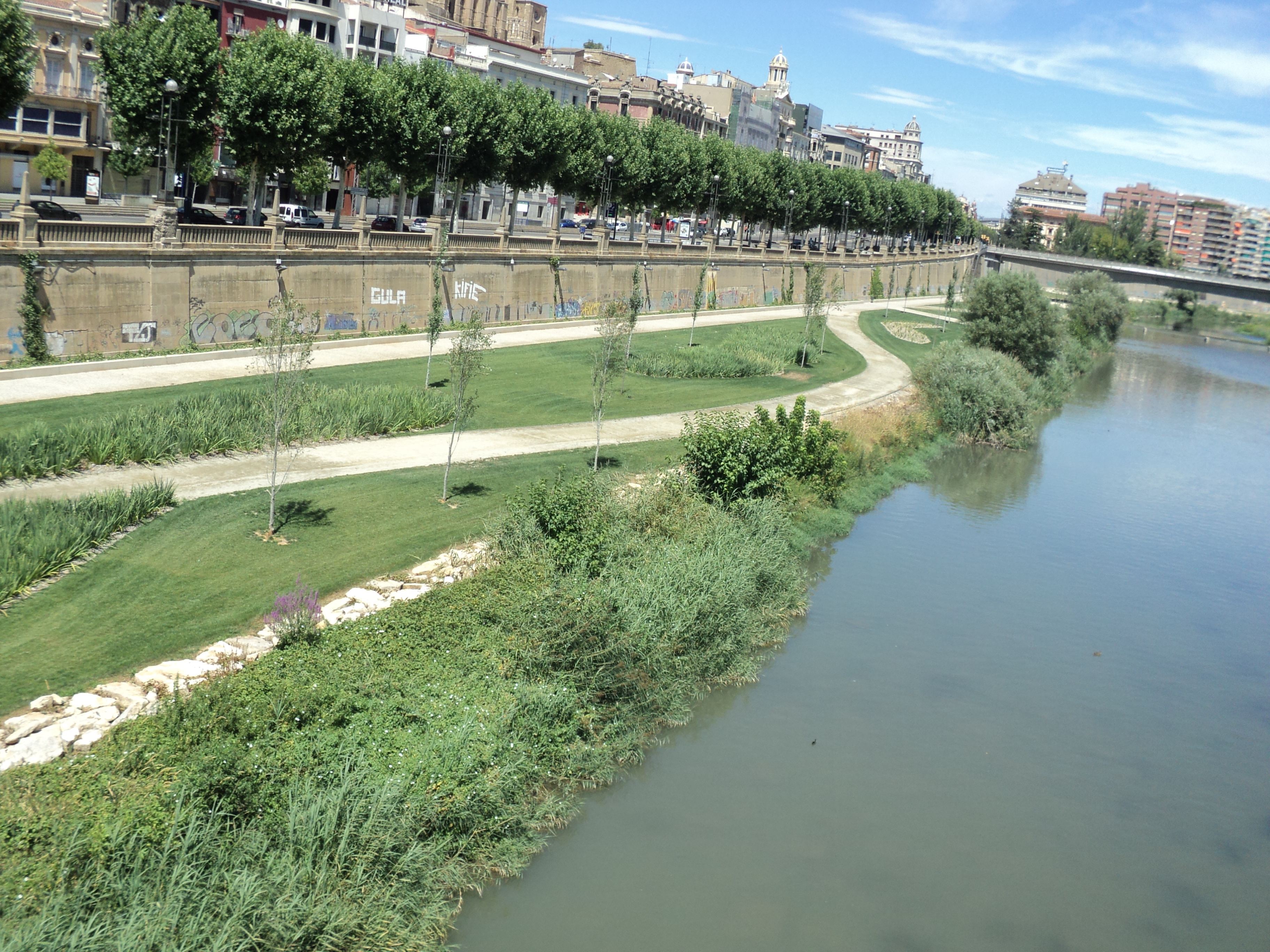
Passing by the River Segre

Passing by the River Segre

Day-2 in this charming city was spent walking around the place, locating department stores & bus stops and figuring out how I’d get to office next morning. My new home seemed great but I was still a little apprehensive about work. This would be my first office-experience outside of India, and I just hoped my colleagues were nice.

Dining with the amazing people from work :-)

Dining with the amazing people from work 🙂

Turns out, they’re the coolest co-workers in all of Lleida! 🙂 I went in thinking I’d have to do a lot of catching up on Catalan & Spanish, but they took one step forward by brushing up their English so they could talk to me! These are the people I lunched with everyday as we exchanged stories from India & Spain.

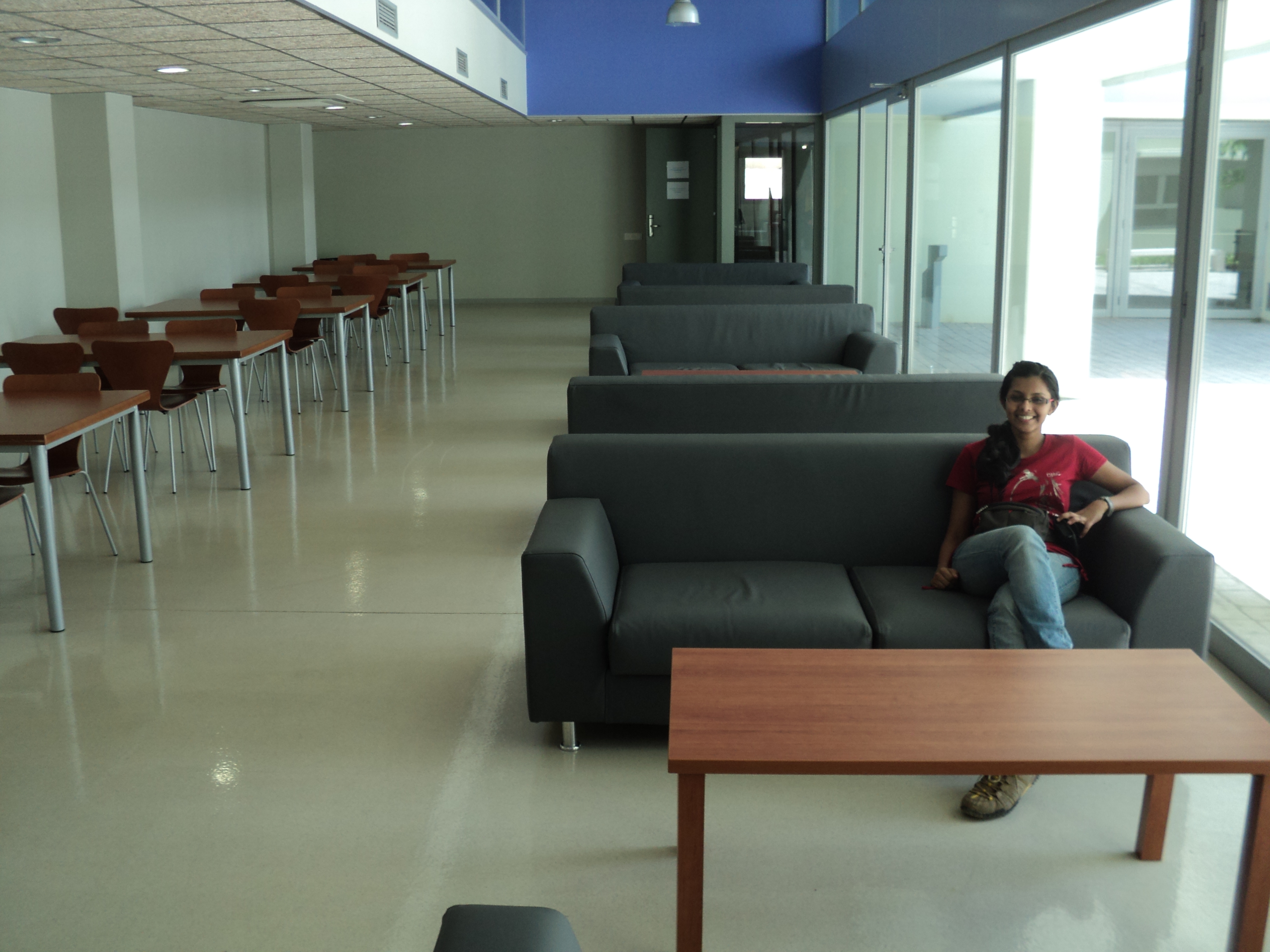
The study underground

The study underground

I could go on and on about how warm and friendly everyone in Lleida is. But now that I’ve introduced you to Catalunya, I’ll keep it mostly travel-centred from my next post. In the pic above, you will see where I sat and planned all my weekend trips in this country that many of us have only dreamt of.

Stay tuned for my next post on Barcelona! 🙂

Sula Vineyards: A Fine-Wine Story

The neat rows of grapevines glistered in the afternoon-sun as I slowly rose up the slope towards 4 gabled structures. I was delighted to see that the climbers, albeit only 4 feet in height, extended as far as my eyes could see. I couldn’t help but feel excited. This was, after all, my first trip to a vineyard!

The famed vineyard at the Sula estate

The famed vineyard at the Sula estate

I had picked an opportune time to visit the Sula Vineyards as I not only beat the tourist-rush of Jan-Mar (the harvest season), but also experienced the beauty of Nashik in the light chill of early December. Nashik is about 3 hours from Mumbai, and the cheapest way to get here is by train. There are plenty of buses and cabs too that ply. I stayed at Ginger Hotel which is only 20 minutes from the winery. Sula also has its own resort on the estate.

The bar/lounge at Sula

Entrance to the wine bar at Sula

It was late afternoon when I reached the Sula property and made my way to their exquisite Indian restaurant – Soma. I glanced through the wine list and ordered a Sula Seco with some appetizers. I took in the interiors as I waited for my first wine of the day. The place is elegantly furnished with wood and wrought iron, and Warli-artwork graces the walls.

Soma-The Indian restaurant

Soma-The Indian restaurant

My sparkling wine arrived with my choice of appetizers – cottage cheese balls and papad. This subtly sweet wine paired well with the spicy vegetable dish and tandoori rotis I ordered for the mains. With lunch behind me, I headed to the reception at the tasting room and bought my pass to the wine tour.

Liquid gold? :D

Liquid gold? 😀

A charming young lad sporting a black Sula-tee was our wine-tour-guide. He told us about the history of the vineyards and how the founder, Rajeev Samant, quit his job in Silicon Valley and started up the winery with some help from a Californian winemaker.

Before you decide to quit YOUR day-job and open your own winery, let me tell you some interesting wine-facts:-

  • The grapes used for producing wine are different from the regular grapes (table-grapes) we consume.
  • Contrary to popular belief, the colour of wine has little to do with the colour of grapes it is made from. This means, red wine can be made from green/white grapes, just as whites can be made from red/purple grapes. (Read ahead to find out how!)
  • Wines can be as young as 3 weeks and can also be aged for several decades! (Of course, the age makes A LOT OF difference to the quality of the wine and the price that it can command.)
Inside the tank-hall

Inside the tank-hall

Our tour began at the crushing pad where grape-juice is squeezed out of the harvested grapes. Grape-crushing has gone huge technological changes since the basket-press-days of yore. Popular activities like wine-stomping (with bare feet) have lead many to believe that’s an integral part of winemaking, but one can’t be further from the truth. If the thought of dirty, stinky feet romping about in a basket full of grapes makes you wretch at the wine you’re drinking, you can heave a sigh of relief! Most commercially produced wines have hardly any contact with the human-skin.

After extracting the grape-juice, your wine (to-be) is stabilized and filtered inside humongous stainless steel wine-tanks installed in a large, cool room called the tank hall. This is where you decide what wine you will produce! White wines are left as they are; for the reds, the grape-skin and twigs are added to the batch; and for rosé (pink wines), very little red wine is added to the white (mostly in 20-80 or 30-70 ratios) depending on the hue that is desired. Tank halls are also used for “blending” of two wines from different regions or grape-varieties (This is where a  Sauvignon Blanc combines with a Chenin Blanc to become a Chenin Sauvignon).

A wine for every barrel!

A wine for every barrel!

The next step is to “barrel” the wine for its storage. Barrels are just as important as the wines that they store. Sula imports its oak barrels for the wine-maturing process. This stage also helps in “clarifying” the wine so the tannins and other insoluble matter can settle at the bottom. The barrel-room is the last area your wine visits before it’s bottled and shipped to  you.

The tasting room

The tasting room

After giving us a wonderful tour of the winery and regaling us with the fascinating story of how a wine is born, our guide took us to the tasting room and handed us each a wine glass. We were taught the art of tasting a wine. Before one tastes wine, one must know the correct way to hold the glass (by the stem or base of the wine glass, and NOT the bowl) as this impacts your view of the colour and the temperature at which you finally taste it (holding the bowl of the glass heats up the wine and affects the flavour).

After you have your grip in place, you must look at the wine and its colour. The colour reveals a lot about the age of the wine. Young reds have a purplish or bluish tint whereas their mature cousins are deep red or orange. Likewise, new whites are green to light yellow, and they age towards a golden hue.

There's a wine for every occasion!

There’s a wine for every occasion!

After observing your wine, swirl it in the glass to let some air mix with it. Aerating the wine enhances its taste so much so that we now have mechanical and battery operated aerators that are used for pouring wines. After aerating, smell the aroma, take a sip and keep it in your mouth for a while for the flavours to reach you. The gulp that you take after doing “all of this”, will make you realize it is worth the effort. Most novices tend to drink their wine like they would their beer or whisky which is why first-timers rarely like their first wines. After you learn the art of drinking wine, you will concede that wine is a superior alcohol and quite deserving of its price-tag.

My wine-tasting ticket entitled me to taste a total of 8 wines:-

  1. Sula Sauvignon Blanc (white)
  2. Dindori Reserve Shiraz (red)
  3. Sula Zinfandel Rosé (rose)
  4. Sula Riesling (white)
  5. Sula Cabernet Shiraz (blended red)
  6. Sula Brut (sparkling)
  7. Sula Late Harvest Chenin Blanc (dessert wine)
  8. Satori Merlot (red)
The amphitheatre

The amphitheatre

The evening was turning dusky when we were done. I stealthily slipped out of the tasting room as the others soaked themselves in conversations, so I could walk over to the lush amphitheatre behind the buildings. This is where music concerts are held every February during the Sula Fest. After sundown, I explored their store and bought a Rasa Shiraz, their finest vintage red which I could take back to my hotel.

A red and a pink, I've got a pair to drink! ;-)

A red and a pink,
I’ve got a pair to drink! 😉

Dinner was an Italian affair at Little Italy, the first restaurant to open at an Indian vineyard. I downed two more wines with a mushroom starter and a plate of ravioli. People will tell you that the best thing about a food-trip is that you taste with your eyes AND your tastebuds. What you discover on your own is that the tasting first comes with your heart. Your sense organs merely act as tools.

* * *

The night sky of Nashik is markedly clear as it isn’t plagued by a metro’s light-pollution. I took this opportunity to indulge in some stargazing before I bid my goodbyes to Sula.

10 Things You MUST do in Pondicherry

This is the winning entry for the Prismma Holiday 2014 contest

(Fortnight of 10-23 March 2014)

In our fast-paced lives, we are always hard-pressed for time. Long vacations are a luxury that even money can’t buy. This is primarily why we must learn to “pack a lot in a little”. With this post, I flag off the 10-Things-Series for the benefit of those who wish to “do-it-all” in the limited time that they can prize out for a trip.

My 2-day trip to Pondy and Auroville seemed short while I was planning it, but turned out to be just right for all the things I set out to do. Here’s a list of things you MUST experience when you find yourself in Puducherry:-

1. Sample the French Cuisine:

Pondicherry isn’t called the ‘French Riviera of the East’ for nothing! There are cosy restaurants on every other lane and most eateries have French dishes on their menu. Ensure at least one meal you have here is unfailingly Français (pronounced fhaan-say). Though vegetarian options are limited (most French delicacies have at least one martyred animal), this cuisine can hold its own against most cuisines that have plenty to offer the herbivores. Here’s what yours truly ate:-

Ratatouille with bread

Ratatouille with bread

2. Sip on some Fine Wine:

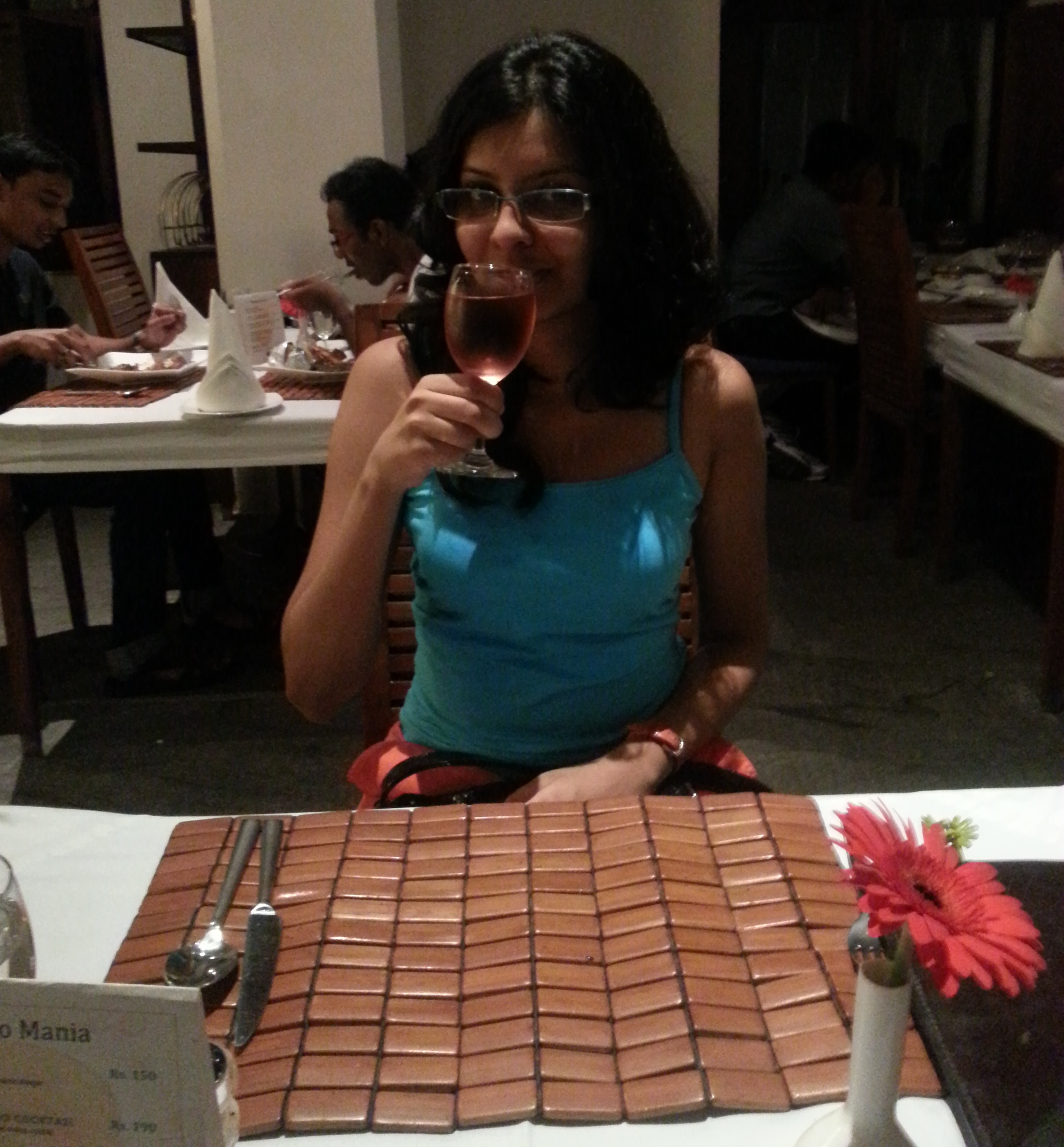
When all the eating is done, can the drink be far behind? The French dining experience remains incomplete without wine. Although Puducherry is not the most famous wine-producing area in India, it imports good wines from across the country and the world. I had a glass of dry Shiraz Rose` which held its acidity boldly against the spicy rice dish that my companion ordered.

Some rose wine to wash down the food

Some rose wine to wash down the food

3. Walk on the Soft Sands: 

Pondy has a beautiful coastline which can be marvelled at from a number of beaches. The Bay of Bengal gleams like a bed of blue sapphires under the setting sun. Promenade Beach is among the better known beaches that skim the posh French side of this city. It is advisable to err on the conservative side while dressing for the waters as there are rarely any sunbathers on the beaches here.

By the Promenade Beach

By the Promenade Beach

4. Ride on a Rustic Rickshaw:

This city is so small that a pair of legs is all you need to travel from one end to the other. For those who’re not very fond of walking, there are bicycles and auto-rickshaws. There’s also the occasional yellow oh-so-French Vespa that zips by. But what makes Pondy so charming is the cycle-rickshaw! Taking this open-roof, doorless ‘green’ vehicle is an incredible way to savour this beautiful city.

Riding on a cycle-rickshaw

Riding on a cycle-rickshaw

5. Look out of a French Window:

The bungalows and buildings in Pondy are indulgent in the way they go all out to to appear French. Apart from the omnipresence of the colour yellow, it is the windows that are strikingly French in their appearance. It is highly recommended to have your afternoon tea by the window so you can appreciate how architecture can make time move slowly.

Let there be light!

Let there be light!

6. Visit a Nursery in Auroville:

Much has been written about the environmentally sustainable ways of Auroville, but to truly be one with nature, one must spend a few hours in the homes of young plants (a.k.a. nurseries). The oxygen I breathed here is one of the purest I’ve breathed in India. Of course, the purity comes not only from the plants but also the committed people that work towards building this universal township.

This nursery has a “green” sky!

7. Stay in a French Bungalow: 

Don’t miss the opportunity of staying at one of the few boutique hotels in White Town (French side of Pondicherry). I stayed at  Le Dupleix, but you can also consider The Promenade (a Hidesign hotel). Most of the residences are spacious, with wooden flooring and glass-walled bathrooms (perfect for honeymooners 😉 ). My hotel had tables laid out on the patio for open-air dining.

20130715_104451

View from my French castle

8. Eat Creole, Vietnamese and Italian:

You don’t have to do everything only the French-way! The restaurants in Pondy can serve up some mean spreads from several other cuisines that you’ll only be too glad to tuck into! Off the top of my head, I can tell you they offer Punjabi, Moghulai and South Indian fares. And, I have personally tried Creole (available only at Le Dupleix), Italian (there’s hardly a place that doesn’t serve Italiano! 😀 ) and Vietnamese (served only at Le Vietnam). Pondy is a gourmand’s paradise in every sense of the word!

Mmm... smells of Vietnam!

Mmm… smells of Vietnam!

9. Spend a Lazy Evening at a Cafe`:

The cafe scene is quite evolved in this Union Territory. The beachfront has a string of cafes that let one ‘do absolutely nothing’. Pondicherry is a place best enjoyed by doing nothing in particular while you let the sea-breeze stroke your face. Le Cafe is the most famous of all the cafes around. But don’t let that stop you from going off the beaten path to experience other little-known cafes.

Conical roofs of a quaint restaurant

Conical straw-roofs of a quaint cafe (Madam Shante’s)

10. Join the Local Activists:

I happened to come across a number of activists on the beach-promenade on St. Bastille’s Day. I gladly took this opportunity to create some awareness about vegetarianism and it benefits. To catch the jamboree and jollity of Bastille’s Day, plan your trip around 14th July.

Vegetarian is the way to go!

Vegetarian is the way to go!

And finally, when you have done all of the above, let me know if my advice was worth it! 🙂

Ville Blanche – Pondicherry’s French Kiss to India

I had been day-dreaming about the quaint little streets of Pondicherry for almost a year before I finally booked my tickets and decided to realise my fantasies.

Earth meets heaven

Where Earth meets Heaven

Puducherry is not just a union territory in India, it is a world of its own. The Franco-rule that lasted here for almost 300 years, has soaked this place in its colours and flavours. To savour the ultimate French experience of La Côte d’Azur de l’Est, I decided to stay at Le Dupleix.

The colonial interiors of the luxury boutique hotel (Le Dupleix)

The colonial interiors of the luxury boutique hotel (Le Dupleix)

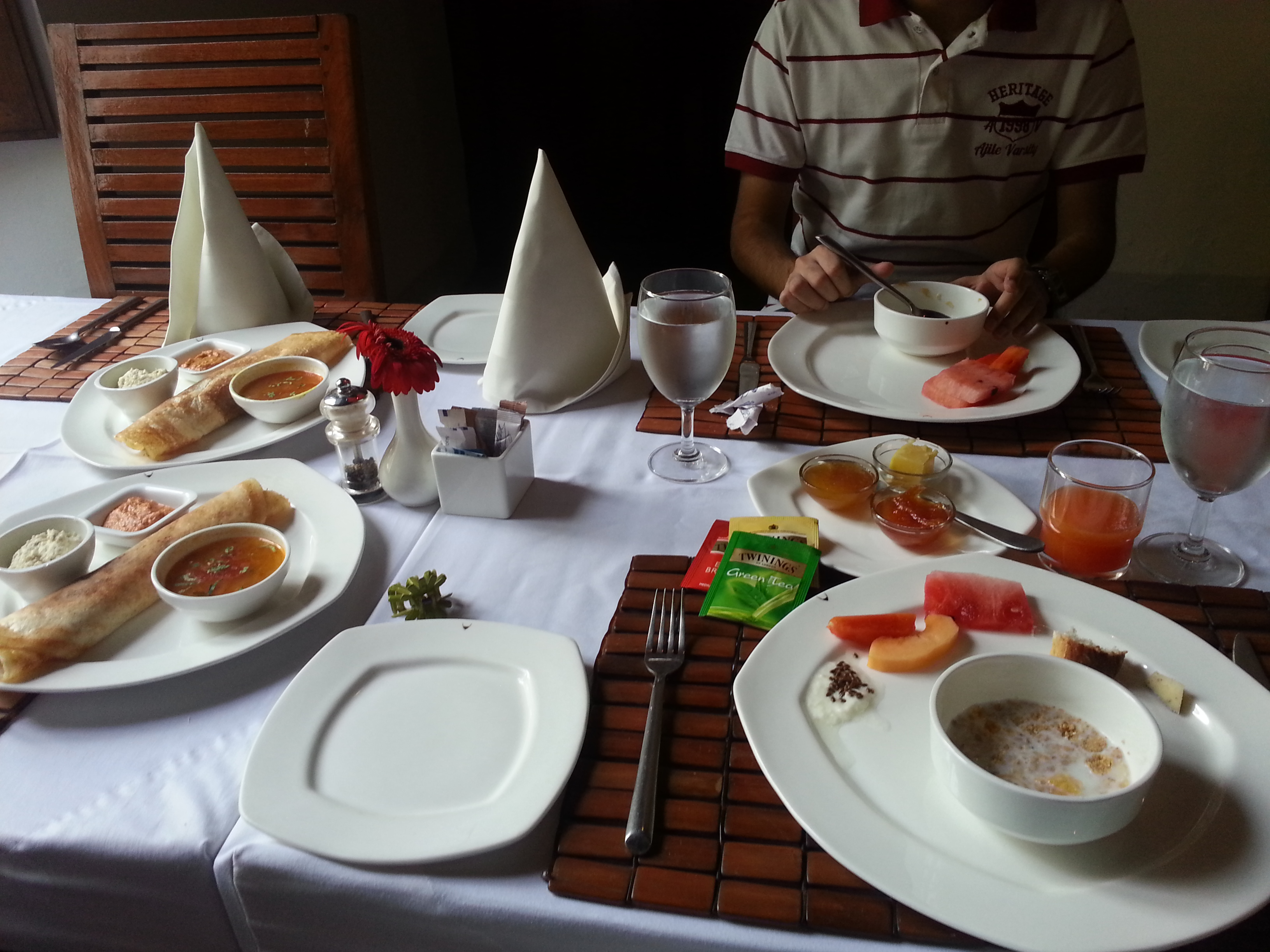
I started my Pondy-trip with a hearty meal of milk and cornflakes, fruits, flax seeds and orange-juice. Then gorged on some dosa-chutney and sambar while I waited for my green tea to arrive. (My appetite doubles when I am on a trip!)

The Tamil-English breakfast

The Tamil-English breakfast

With my stomach full, I started walking through the grid-like rues (roads) that lead me to this mustard building…

The French Embassy

The French Consulate

And then, there was another. This one in memory of the French soldiers.

Foyer du Soldat

Foyer du Soldat

I entered the Pondicherry Museum, which housed everything – from stone-sculptures dating back to the 1st century AD to ancient carriages that lived to see me visit!

Vintage carriages

Vintage carriages

To pay some heed to my roused hunger, I halted in front of Le Vietnam, where I had my lunch of bún chả with a pair of chopsticks while I stared wide-eyed at an interesting looking nón lá (Vietnamese conical leaf hat).

Post lunch, I rushed to the nearest church, just in time to hear the mass in Tamil!

Our Lady of the Immaculate Conception cathedral

Our Lady of the Immaculate Conception cathedral

I reached the Promenade beach before sunset and walked the entire stretch. The locals told me I should stop to look at the Gandhi statue and the French war memorial, which I dutifully did.

When the sun dissolved into the waters of the Bay of Bengal, the street suddenly came alive! One could watch the Pondy-Police-Force play the trumpet, activists staging street plays, live music and dancing all along the way. The once empty road was now thronged by a sizable crowd, and the mood was that of a carnival. It was, in fact, a carnival as today was St. Bastille’s Day! I was just lucky to be at the right place at the right time.

Bastille Day festivities

Bastille Day festivities

After the noise-overdose, I had a quiet dinner at my hotel. I ordered Italian – the cuisine that makes me think of nothing else but what’s on my plate. I then proceeded to catch some sleep for my trip to Auroville the next day!

Ravioli con funghi (Ravioli with mushroom)

Ravioli con funghi (Ravioli with mushroom)